
The RBE and your Luxembourg ASBL: what your non-profit must declare
Register of Beneficial Owners in Luxembourg: who your ASBL must declare, how to register with the LBR, sanctions for failure to file. An up-to-date pillar guide.
📅 Last verified: 25 May 2026. This article applies the law of 13 January 2019 establishing a Register of Beneficial Owners (RBE) and its implementing regulations, takes into account the CJEU judgment WM/Sovim of 22 November 2022 (restriction of public access to the RBE), and connects with the law of 7 August 2023 on non-profits and foundations. The remaining areas of interpretation are flagged in "Grey area" callouts in the text.
The essentials in 30 seconds
- The RBE has been mandatory for nearly every Luxembourg ASBL (association sans but lucratif — Luxembourg's non-profit association legal form) since 1 March 2019, with no size threshold and no exemption by field of activity.
- The point is to declare the directors currently in office: in the absence of share capital, the persons targeted are those who effectively control the association.
- Registration is done online on the Luxembourg Business Registers (LBR) platform, in roughly 30 minutes the first time and 10 minutes for subsequent updates.
- Any change in the composition of the board of directors must be declared within one month.
- Sanctions range from a warning to criminal fines of €1,250 to €1,250,000 (article 23 of the law of 13 January 2019) — the maximum amounts are rarely applied to ASBLs in practice, but a prolonged failure can now feed the administrative dissolution file introduced by the law of 7 August 2023.
📥 Free RBE checklist — registration, updates, sanctions (lead magnet to be produced — see brief 06)
A printable 2-3 page PDF, to keep alongside your association's file as an annual reminder.
Download the checklist → (URL to be created once the PDF is produced)
Introduction
The Register of Beneficial Owners — RBE in the Luxembourg Business Registers' correspondence — is one of those obligations that lands heavily on the morale of volunteer treasurers. An administrative acronym, a distant link to the fight against money laundering, a LBR landing page that does not make first steps easy: the whole thing can feel like a bureaucratic trap reserved for experts.
The reality is simpler. For the vast majority of Luxembourg ASBLs, the RBE is a formality of roughly thirty minutes the first time, ten minutes per annual update. It consists of declaring who effectively controls your association — that is, in practice, who sits on your board of directors — and transmitting a few identity documents. Once the routine is in place, compliance maintains itself, provided you build the "RBE update" reflex into the day after every general meeting that changes the composition of the board.
This article takes stock of what an ASBL needs to know, without unnecessary AML/CFT jargon, but with enough precision to answer the questions that come up most often: am I really concerned, who must I declare, how do I go about it, and what is the real risk of forgetting.
What is the RBE, and why does it exist?
The Register of Beneficial Owners is a public file, maintained by Luxembourg Business Registers, which lists for each Luxembourg legal entity (commercial companies, ASBLs, foundations, equivalent bodies) the identity of the natural persons who control it. The principle is one of transparency: behind every legal structure, it must be possible to identify human beings, not an opaque cascade of entities.
An obligation of European origin
This obligation is not a Luxembourg invention. It flows directly from Directive (EU) 2015/849 of 20 May 2015 (known as the "4th Anti-Money-Laundering Directive" or 4AMLD), supplemented by Directive (EU) 2018/843 (5th Anti-Money-Laundering Directive or 5AMLD). These two texts require every Member State of the European Union to maintain a national register of beneficial owners accessible to the authorities, to entities subject to anti-money-laundering rules (banks, notaries, lawyers, accountants), and, under certain conditions, to other parties.
Luxembourg transposed this obligation through the law of 13 January 2019 establishing a Register of Beneficial Owners, supplemented by the Grand-Ducal regulation of 15 February 2019 which sets out the technical details (data format, filing platform, access rights, fees). The register has been operational since 1 March 2019, with an initial six-month deadline (until 1 September 2019) to allow existing entities to carry out their first registration, together with a fee exemption during this transition period (article 13 of the Grand-Ducal regulation of 15 February 2019).
Why are ASBLs concerned?
It is a fair question: a municipal brass band or a local pétanque club does not look like a money-laundering vehicle. The answer is that the European legislator chose a broad perimeter as a precaution: any entity endowed with legal personality could, in theory, be used to conceal financial flows. Rather than defining thresholds or activity-based exemptions (with the risk of leaving cases out), the directive opted for universal coverage, leaving the least exposed entities to file a simple declaration.
In concrete terms, this means that a Luxembourg ASBL is treated, when it comes to beneficial-owner transparency, in the same way as a commercial company. The information required is proportionate to the nature of the structure (no share capital to declare for an ASBL), but the reporting obligation exists on the same basis.
📚 Going further — Recital 12 of the 4th Directive sets out clearly the intent of the European legislator: « L'identification des bénéficiaires effectifs et la vérification de leur identité […] devraient s'étendre aux entités juridiques qui possèdent d'autres entités juridiques. » — in English: the identification of beneficial owners and verification of their identity should extend to legal entities that own other legal entities. The transparency logic therefore covers any structure endowed with legal personality, ASBLs included.
Are all ASBLs concerned?
The short answer is yes — nearly all of them. A few special cases nevertheless deserve a careful read.
The general rule
All ASBLs registered with the Luxembourg Trade and Companies Register (RCS — Registre de Commerce et des Sociétés) are subject to the obligation to register with the RBE, with no size threshold, no exemption by field of activity, regardless of turnover or number of employees. A neighbourhood brass band with no employees and €2,000 of annual membership fees has exactly the same reporting obligation as a large employer-ASBL with 50 staff — only the content declared differs (the number of directors varies), not the principle.
This rule flows from article 1 §4 of the law of 13 January 2019, which targets « les entités immatriculées au registre de commerce et des sociétés visées à l'article 1er, points 2° à 16°, de la loi modifiée du 19 décembre 2002 » — in English: entities registered with the Trade and Companies Register referred to in article 1, points 2° to 16°, of the amended law of 19 December 2002. This list encompasses ASBLs and foundations — a point confirmed by the Ministry of Justice's FAQ and by the dedicated pages of Guichet.lu.
Foundations: same regime, same obligations
Luxembourg foundations are also subject to the RBE. For them, the beneficial owners declared typically include the founder, the members of the board of directors, and, where relevant, the beneficiaries of distributions if the foundation has a redistributive character. The registration procedure is identical to that of ASBLs.
The special cases worth knowing
| Situation | Subject to RBE? | Note |
|---|---|---|
| Standard ASBL registered with the RCS | Yes | General rule |
| ASBL recognised as of public utility | Yes | No exemption attached to public-utility status |
| Luxembourg foundation | Yes | Regime equivalent to ASBLs |
| ASBL in the process of being established | Not yet | Time allowed to register after RCS registration |
| De facto association (without legal personality) | No | No RCS registration, therefore no RBE — but also no legal personality |
| Temporary association (1928 law, residual regime) | To be checked case by case | Specific regime, situation to clarify with an adviser |
| Foreign ASBL carrying out an activity in Luxembourg | Specific case | Regime depending on the nature of the presence (branch, agent, mere activity) |
| AISBL (international non-profit association) | Yes in principle | Equivalent regime; check specifics with the LBR |
💡 A useful reflex — If your ASBL appears with a registration number on the LBR website (
lbr.lu), it is registered with the RCS, and therefore subject to the RBE. To check, type the name of your association into the LBR public search: if you get an RCS record, you are within the perimeter.
Who is a "beneficial owner" for an ASBL?
This is the question that most disorients treasurers, and it is also the central section of the topic.
The concept and its commercial origin
The notion of "beneficial owner" was originally designed for commercial companies. For a private limited company or a public limited company, the beneficial owner is defined as any natural person who holds, directly or indirectly, more than 25% of the share capital or voting rights, or who exercises equivalent control by other means.
This definition works well for capital structures. But an ASBL has neither share capital, nor shareholders, nor voting rights proportional to an investment. So who is to be identified?
The transposition for ASBLs: effective control
The European legislator, and after it the Luxembourg legislator, provided for a subsidiary clause for entities without capital. Failing the ability to identify economic owners in the commercial sense, the rule targets the natural persons who exercise effective control over the entity — that is, those who take the strategic decisions and bind the association.
In practice, for a Luxembourg ASBL, this translates into: the directors currently in office (members of the board of directors) are considered to be the beneficial owners. All of them, with no distinction by role (president, treasurer, secretary, director without specific portfolio). This identification flows from the general definition of beneficial owner set out in article 1 §7 of the amended law of 12 November 2004 on the fight against money laundering, applied to entities without share capital — the law of 13 January 2019 on the RBE expressly refers back to this general definition (article 1 §3). It is the consistent position of LBR practice and of the majority Luxembourg doctrine.
The decision tree
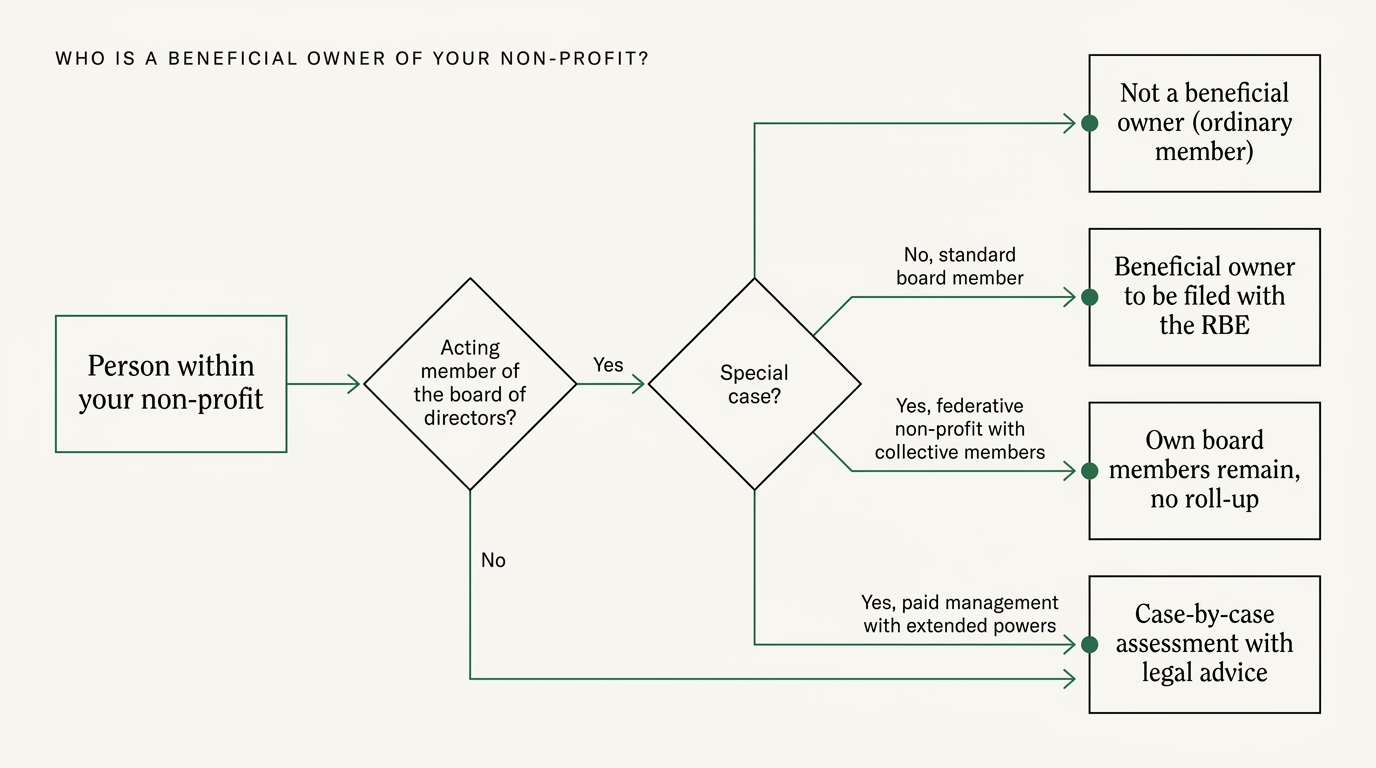
Special cases worth knowing
The president with a casting vote — their institutional role does not change their status as beneficial owner: they are one on the same basis as the other directors, no more, no less.
The founder still in office — if the founder of an ASBL is also a director, they are declared as a beneficial owner on that basis. If they have stepped down from the board but retain informal influence, the doctrine is more nuanced (see the "Grey area" callout below).
The special agent endowed with extensive powers — a person who is not a director but who holds a general power of attorney allowing them to bind the association on their own for significant amounts can, in certain cases, be considered a beneficial owner. To be examined case by case, ideally with legal counsel.
⚠️ Grey area — The salaried director who is not a board member
A recurring question: if an ASBL has a salaried director who runs operations but is not a member of the board of directors, must they be declared as a beneficial owner?
The LBR's position is not explicitly settled. The majority doctrine holds that no: the beneficial owner targets persons who exercise legal and strategic control, not an executive function. But if the director has a very broad delegation (bank signing without threshold, contractual commitments without board validation), a cautious reading might lead to including them.
In case of doubt about a structure with a strong salaried management, the reflex is to submit the question to the Veräin legal review AI agent (or to an external adviser) before registration.
📚 Going further — The Luxembourg doctrine on the beneficial owner of ASBLs is regularly commented on by the law firms Kleyr Grasso, Molitor, Loyens & Loeff and Arendt & Medernach. Their analyses are accessible via their online publications (newsletters, articles). The LBR's FAQ on the RBE is also a reference source for practical cases.
The information to declare
For each beneficial owner identified, the ASBL must transmit to the LBR a standardised identity record. The content is strictly defined by article 3 of the law of 13 January 2019.
Exhaustive list of data items
| Field | Expected format | Supporting document |
|---|---|---|
| Full first name(s) and surname | As shown on the official identity document | Copy of identity document (ID card, passport) |
| Date of birth | DD/MM/YYYY | Identity document |
| Place of birth | Municipality and country | Identity document |
| Nationality/ies | All nationalities held | Identity document |
| Country of residence | Country code | Proof of residence if requested |
| Precise address — private or professional, at choice | Complete and up to date (street, number, postcode, city, country) | Identity document or proof of address as applicable |
| Luxembourg national identification number (matricule, 13 digits) | For Luxembourg residents | Social security card |
| Equivalent foreign identification number | For non-residents | Official document from the country of residence |
| Nature and extent of the interest held | "Member of the board of directors", with possible specification of role | — (textual description) |
The sensitive point: the address to declare
The address is the most delicate piece of information on the list, but the law provides important flexibility: the beneficial owner may choose to declare either their private or their professional address (article 3 §1 point 9° of the law of 13 January 2019). There is no obligation to enter the personal home address.
For directors performing sensitive functions (criminal defence lawyers, journalists, magistrates), the first decision is this choice between private and professional address, before considering any other step. The professional address of a law firm, chambers or employer is perfectly acceptable.
For cases where even this option is not enough — a concrete demonstrated risk for the person — the law additionally provides for an access restriction procedure (article 15): the data stays in the register but its access is restricted to national authorities, credit institutions, bailiffs and notaries only. The grounds are exhaustively listed: disproportionate risk, fraud, kidnapping, blackmail, extortion, harassment, violence, intimidation, or the minor or incapacitated status of the beneficial owner. The restriction is granted for a maximum renewable period of three years, against increased administrative fees (€15 for the declaration + €200).
Whichever option is chosen, since the CJEU judgment WM/Sovim of November 2022, public accessibility of the RBE is moreover strongly restricted: the data are no longer consultable by the general public without demonstrating a legitimate interest (see the dedicated section below).
💡 Practical case — A female director residing in Belgium with a sensitive professional activity (criminal defence lawyer) wishes to limit the public exposure of her home address. The correct answer is not to declare a false address, nor to use the ASBL's address as a domicile: it is to declare her chambers' address rather than her private address — the law expressly allows this (article 3 §1 point 9°). If a concrete personal risk justifies it, she can additionally request the access restriction procedure under article 15.
Registration procedure: step by step
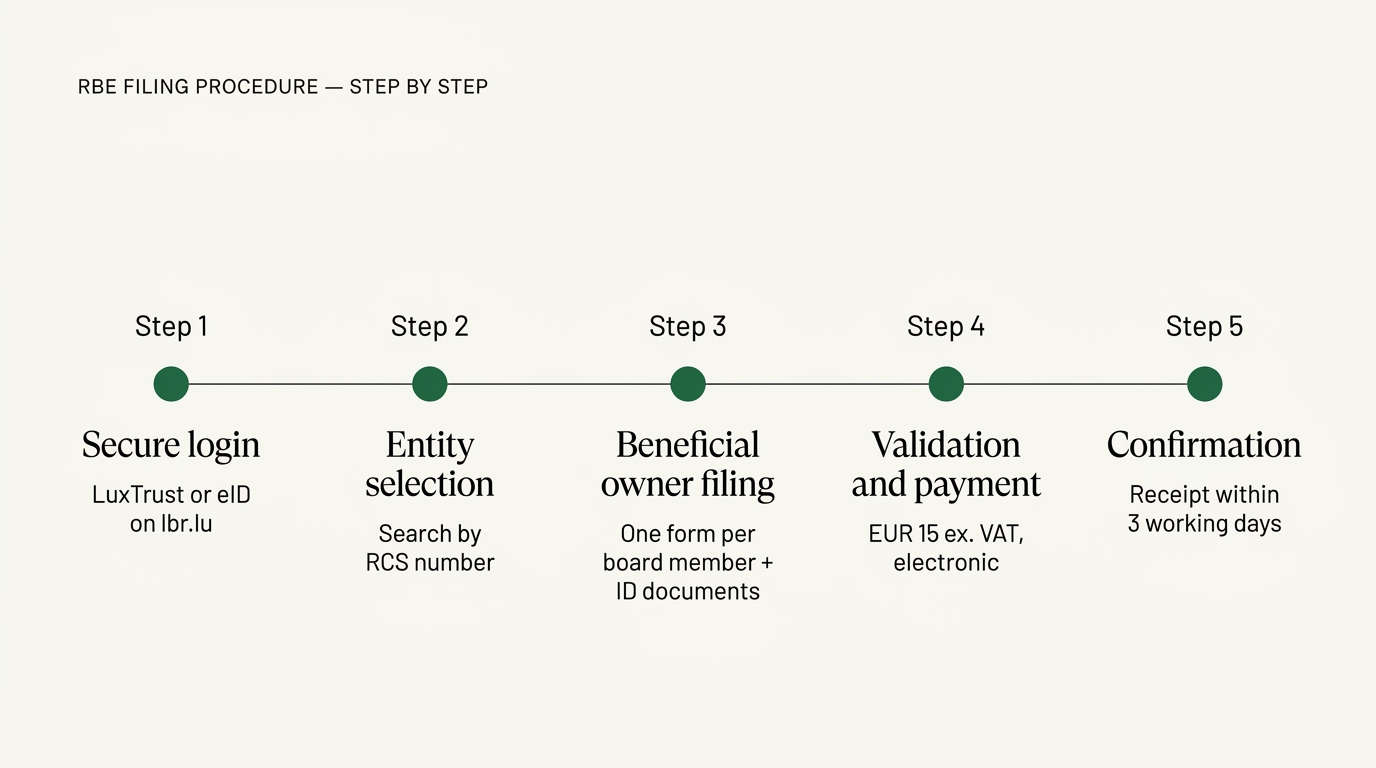
Registration is done entirely online, on the Luxembourg Business Registers platform.
Step 0 — The technical prerequisites (one-off)
Before you can log in to the RBE platform, you must hold an electronic authentication means recognised by the LBR. The Grand-Ducal regulation simply refers to a "holder of an electronic certificate" (article 1 §4) without qualifying the technology; in LBR's operational practice, the recognised options are:
- LuxTrust (Smartcard, Token, Signing Stick or LuxTrust Mobile) — the historical solution, paid (~€30-40 per year depending on the format)
- Luxembourg eID (the chip on your identity card activated with PIN/PUK) — free for residents
- For foreign directors without LuxTrust or eID — an alternative procedure exists via eIDAS authentication (European interoperability) or through a mandate given to a Luxembourg professional (lawyer, fiduciary). To be documented case by case depending on the country of residence.
💡 Practical tip — If RBE registration is carried by a single person (often the president or treasurer), a single authentication means is enough: that person files on behalf of the association, after collecting the identity documents of the other directors.
Step 1 — Connection to the LBR platform
- Go to lbr.lu
- "Register of Beneficial Owners" section
- Click on "Professional access" (and not "Public search", which is only for consultation)
- Authenticate with LuxTrust or eID
Step 2 — Selection of the entity
- Search for your ASBL by its RCS number (format
Ffollowed by digits, e.g.F12345) - Check that you are authorised to file for this entity (the system verifies your status as a director against the data already recorded with the RCS)
⚠️ If you are not recognised as authorised — this is typically the case if your appointment as a director has not yet been published with the RCS, or if you have been co-opted without formalisation. The procedure then consists of first filing the board update with the RCS (minutes of the AGM or board meeting, declaration of amendment), then returning to the RBE once the situation is reflected.
Step 3 — Entry of the beneficial owners
- One form per person to be declared
- Manual entry of the fields (see exhaustive list above)
- Languages accepted: French, German or Luxembourgish, at choice (article 2 of the Grand-Ducal regulation of 15 February 2019)
- Upload of supporting documents: identity document of each beneficial owner in PDF or image format
- Save available at each step to resume later
⚠️ If the LBR rejects the registration for incompleteness or non-compliance, the ASBL has 15 days from the request for rectification to comply (article 7 §1 of the law). Failing this, the refusal procedure is initiated and the file may be transmitted to the public prosecutor. The vast majority of refusals are resolved in practice within this period by simply adding the missing documents.
Step 4 — Validation and payment
- Full review before validation
- Fee: €15 excluding VAT (around €17.55 including 17% VAT) for an initial registration as well as for an amendment, under annex A of the Grand-Ducal regulation of 15 February 2019 (consolidated on 24 March 2025)
- Electronic payment (bank card or transfer)
- Surcharge in case of delay: +€50 if the declaration is made during the second month following the event, +€200 between the third and the fourth month, +€500 from the fifth month onwards (article 6bis of the Grand-Ducal regulation of 15 February 2019)
Step 5 — Confirmation
- The LBR has a legal period of 3 working days to process the application (article 6 §2 of the law)
- Confirmation email sent by the LBR
- Keep the certificate in the ASBL's permanent file: it is the proof to produce in case of a subsequent inspection
Procedure diagram
Update obligation: one month after any change
The RBE is not a one-off formality. Any change in the composition of the board of directors must be declared to the LBR within the month following the change (article 4 §1 of the law of 13 January 2019). This is the point where most ASBLs become unintentionally non-compliant: the initial registration is done, then the reflex is lost over successive AGMs.
The triggering events
Four situations require an RBE update within the month:
- Election of a new director (at the annual AGM or an extraordinary AGM)
- Resignation, removal or non-renewal of a director
- Change of private residence address of a director in office
- Change of nationality of a director (marriage, naturalisation, loss of nationality)
- Death of a director — the declaration follows, in practice, the formalisation of the replacement by the board or the AGM
To this list one should add, more rarely, a change of identity (marriage, transcription of a change of first name) which must also be reflected.
The update procedure
The update procedure is identical to that of the initial registration, but much quicker: the existing data are pre-filled, you only need to amend what has changed (remove an outgoing director, add a new director with their full record, amend an address). Expect 10 to 15 minutes for a standard update.
The reflex to put in place
The management trick that makes the difference: build the RBE check into the minutes of every general meeting. A single line in the minutes of the ordinary AGM is enough: "The board of directors confirms that the RBE registration is up to date as of [date], and shall carry out the required update within the month following any change decided today."
This mention anchors the reflex at the precise moment when it is useful (the AGM is typically where the composition of the board changes), and forms internal evidence of due diligence in case of a subsequent inspection.
💡 For ASBLs with a high board turnover — If your board of directors changes substantially from one year to the next (student associations, youth structures, brass bands with traditional rotation), block out 15 minutes in the diary of the new president from the first week after the AGM, dedicated to the RBE update. It is the gesture that prevents the oversight.
The parallel obligation: keep the documents at the seat
Beyond the declaration to the RBE, article 17 §2 of the law of 13 January 2019 requires the ASBL to keep, at its registered office, the information on its beneficial owners and their supporting documents — in other words, a copy of the identity documents of each director, accessible at the seat in case of an inspection. This obligation is separate from the declaration to the RBE and is sanctioned separately (article 21 §1).
In practice, the simple reflex is to keep, in a "Governance" binder at the seat (or in a secured digital folder), a scanned copy of the identity documents of the directors in office, updated at each renewal of the board of directors. The same obligation extends to retention for five years after the deregistration of the ASBL in case of dissolution, in a designated place published in the RESA (article 17 §4).
Sanctions and risks in case of non-compliance
This is the section that worries readers, and the ambient tone (specialist press, certain law firms) tends towards alarmism. Let us calibrate.
The legal framework of sanctions
Before the criminal sanction, there is a graduated administrative surcharge applied by the LBR when the declaration is made out of time (article 6bis of the Grand-Ducal regulation of 15 February 2019, annex A):
- +€50 if the declaration is made during the second month following the event
- +€200 between the third and the fourth month
- +€500 from the fifth month onwards
These are, in the vast majority of cases, the only concrete sanctions a late ASBL will encounter — a few tens to a few hundred euros, no more, on top of the standard €15 excluding VAT for the declaration itself.
Beyond these surcharges, articles 20 and 21 of the law of 13 January 2019 provide for criminal fines of €1,250 to €1,250,000, applicable in five distinct situations:
- Failure to register or update within the legal deadlines (article 20 §1)
- Intentional false declaration to the RBE — inaccurate, incomplete or out-of-date information knowingly transmitted (article 20 §2)
- Failure to keep the information at the seat of the ASBL (article 21 §1, see also the parallel obligation set out above)
- Communication of inaccurate information to national authorities or professionals subject to AML/CFT rules (article 21 §2)
- Refusal by the beneficial owner themselves to transmit their information to the ASBL (article 21 §3) — that is, in practice, a director who refuses to communicate their identity documents to the president in charge of the declaration
The maximum of €1,250,000 is dissuasive, but it targets extreme cases (intentional false declaration in a money-laundering scheme). For a negligent ASBL without fraudulent intent, observed practice sits at a much lower level — when a criminal fine is mobilised at all, which remains rare.
The reality of enforcement for ASBLs
⚠️ Grey area — Precise statistics on sanctions applied to ASBLs
Public figures on sanctions actually pronounced against ASBLs for RBE breaches remain partial. A few known elements:
- The specialist press (Paperjam in particular) reported 85 formal records drawn up over the April-July 2023 period by the Economic and Financial Crime Section of the judicial police in connection with RBE inspections, without specifying the number of ASBLs among these files or the follow-up given by the public prosecutor.
- An estimate circulates of "1,250 non-compliant ASBLs" with the RBE in 2023, but its precise source and methodology remain to be documented.
- No official annual statistics on the fines actually pronounced against ASBLs are, to our knowledge, published at the time of writing.
An update of this section will be integrated as soon as a more precise source (official statistics from the economic and financial public prosecutor, response to a parliamentary question) becomes available.
What can be said with confidence, given the public information available:
- Spontaneous regularisation is always viewed more favourably than a default discovered during an inspection. If you realise your ASBL is not in order, do not delay: file immediately, without waiting for a possible reminder.
- Inspections do exist; they target as a priority the most exposed structures (large amounts, AML/CFT-risk activities), but a standard ASBL is not immune from a routine check.
- First breaches discovered without fraudulent intent typically lead to a warning and a deadline for regularisation, not immediately to a maximum fine.
Beyond fines: three practical risks
The criminal fine is not the only risk. Three practical consequences of a prolonged failure to register with the RBE are worth knowing:
1. Administrative blockage. The LBR may refuse to issue certain RCS certificates as long as the RBE situation is not regularised. This is awkward if your ASBL needs an RCS extract to open a bank account, sign a public grant agreement or bid for a contract.
2. Banking mistrust. Luxembourg banks, under their own AML/CFT obligations, now systematically check the RBE status of their ASBL clients. A default can lead to enhanced justification requests, or even temporary freezing of transactions pending regularisation.
3. Administrative dissolution (new since 2023). The law of 7 August 2023 on non-profits and foundations has introduced an administrative dissolution without liquidation procedure for ASBLs inactive with the RCS for five years. If a prolonged failure to register or update with the RBE adds to general inactivity with the RCS, the ASBL becomes a natural candidate for this procedure. For a structure that is dormant but that former directors might wish to reactivate someday, it is a warning signal.
📚 Going further — The administrative dissolution procedure is detailed in our pillar on the law of 7 August 2023 and will be the subject of a dedicated cluster article Administrative dissolution without liquidation: is your ASBL at risk? (forthcoming).
Special cases and grey areas
A few situations fall outside the standard framework and deserve a careful read. The doctrine is not always settled, and LBR practice evolves.
ASBL with collective members (other ASBLs as members)
Where an ASBL counts other ASBLs among its members (a frequent case in sectoral federations), a question arises: must one "trace up" the chain to identify the ultimate beneficial owners?
According to observed LBR practice: the beneficial owners of the federative ASBL remain its own directors, with no systematic upward tracing to the member ASBLs. Transparency on the latter is ensured by their own individual RBE declarations. This position is not explicitly codified in the law or the regulation — to be checked against current LBR documentation in case of a complex configuration (cascades of entities, indirect control via an agreement).
ASBL with a large number of directors
Some ASBLs (sectoral associations, representative structures) have 15, 20, sometimes 30 directors. All of them must be declared, with no reduction threshold. The work is longer the first time, but the update then only covers the occasional changes.
Refusal by a director to communicate their private address
This situation is rare but it exists, typically among directors performing sensitive functions (magistrates, investigative journalists, exposed professionals). The legal position is clear: the declaration is mandatory, and refusal exposes the director (and the ASBL) to sanctions. The interaction with the GDPR does not play in favour of an exemption: the AML/CFT directive and its Luxembourg transposition constitute a specific legal basis within the meaning of article 6.1.c of the GDPR.
The relevant route, when a personal risk is demonstrated, is the access restriction procedure provided for by the law (the data stays in the register but its public access is limited or suspended by reasoned decision). This procedure is not an automatic right: it requires the demonstration of a concrete risk to the person.
The effect of the CJEU WM/Sovim judgment (November 2022)
⚠️ Grey area — Access to the RBE in 2026
The WM/Sovim judgment handed down by the Court of Justice of the European Union on 22 November 2022 (joined cases C-37/20 and C-601/20) invalidated the provision of the 5th Anti-Money-Laundering Directive that made the register of beneficial owners accessible to the general public without restriction of quality. The Court held that this general opening was disproportionate in the light of the right to private life (articles 7 and 8 of the Charter of Fundamental Rights of the EU).
Immediate consequence in Luxembourg: the LBR suspended general public access to the RBE from 23 November 2022. Since then, access is restricted to:
- Competent national authorities (judicial police, public prosecutor, financial intelligence unit, supervisory administrations) — access maintained without restriction
- Entities subject to AML/CFT (banks, notaries, lawyers, accountants, etc., in the context of their due diligence obligations) — access maintained
- Persons with a "legitimate interest" (journalists, NGOs, researchers) — access possible upon demonstration of such interest, under a procedure whose precise modalities have been refined since 2023
Area to monitor: post-Sovim regulatory developments continue. A new EU directive (anti-money-laundering package finalised in 2024, now being transposed in Member States) clarifies the access modalities and the scope of "legitimate interest". The exact state of the law applicable in Luxembourg in June 2026 (transposed text, operational modalities on the LBR platform) must be checked at the time of publication. This section will be updated accordingly.
What to do now
The goal is not to overturn your operation, but to identify the right action depending on your current situation.
If you have never registered your ASBL with the RBE
- Gather the documents: ID card or passport of each director in office, their Luxembourg matricule number (for residents), an up-to-date residence address.
- Download the Veräin RBE checklist (lead magnet forthcoming) so you have the list in front of you during the declaration.
- Proceed with the registration this week on lbr.lu, RBE section. Expect 30-45 minutes for a first registration. Spontaneous regularisation is always viewed more favourably than a prolonged default.
If your registration is old but not kept up to date
- Log in to the LBR platform and consult the current RBE record of your association.
- Compare with the actual composition of your board as of today: are the directors who have left since your last update still listed in the RBE? Are the new ones included?
- Make the changes: 10 to 15 minutes per standard update.
- Put the reflex in place: a line "RBE checked and up to date as of [date]" in the minutes of every AGM.
If you are up to date
- Well done — you are among the compliant ASBLs.
- Note the date of last verification in your ASBL's permanent file.
- Plan an annual review (even 10 minutes the day after the AGM) to confirm consistency between the actual composition of the board and the RBE record.
Frequently asked questions
Q: Our president is a foreigner without LuxTrust or eID — how do we manage the registration? A: Three possible solutions. (1) Another director resident in Luxembourg (often the treasurer) files on behalf of the association — they simply need to collect the president's identity documents. (2) eIDAS authentication if your president holds an electronic identification means recognised in their country of residence (Belgian eID, German eID, etc.). (3) A mandate given to a Luxembourg professional (lawyer, fiduciary) who files on behalf of the ASBL.
Q: Must we declare ordinary members (non-directors) to the RBE? A: No. Ordinary members of an ASBL are not beneficial owners within the meaning of the RBE. Only directors in office (and, where relevant, persons with equivalent control powers) are declared.
Q: Can a failure to register with the RBE block our bank account? A: Not directly, but indirectly yes. Banks check the RBE status of their ASBL clients under their own AML/CFT obligations. A default can lead to requests for regularisation, to a temporary freezing of sensitive operations, or to refusal of a new account opening. Prompt regularisation unblocks the situation.
Q: How much does a registration or an update cost? A: €15 excluding VAT (around €17.55 including 17% VAT) for an initial registration as well as for an amendment, under annex A of the Grand-Ducal regulation of 15 February 2019 (consolidated on 24 March 2025). A surcharge applies in case of delay: +€50 if the declaration is made during the second month following the event, +€200 between the third and the fourth month, +€500 from the fifth month onwards.
Q: Who can consult our RBE record in 2026, since the WM/Sovim judgment? A: General public access was suspended in November 2022. Today, the following can access the RBE: competent national authorities (without restriction), entities subject to AML/CFT in the context of their due diligence obligations (banks, notaries, lawyers, accountants), and persons demonstrating a "legitimate interest" (journalists, NGOs, researchers) under a dedicated procedure. The precise modalities continue to evolve since 2023 (area to monitor — see dedicated section).
Q: Must we register a director who has been co-opted before validation by the AGM? A: Yes, as soon as the co-optation is formalised by the board of directors and produces its legal effects (generally immediately, unless the bylaws provide otherwise). The one-month period for the RBE declaration runs from this formalisation, not from the subsequent ratification by the AGM.
Q: Our ASBL is small (three directors, annual budget of €5,000). Are we really concerned? A: Yes, with no exemption. The RBE applies with no size threshold to any ASBL registered with the RCS. Good news: three directors means three records to fill in once, then ten minutes per subsequent update. The total annual effort remains very limited.
Q: Must we file a fresh full registration each time a director's mandate is renewed? A: No. The renewal of an existing director's mandate does not in itself trigger an RBE update (there has been no change of person). Only actual changes in composition (new arrival, departure, amendment of a declared item) require an update.
Going further
- The law of 7 August 2023 explained simply — reference pillar on the general legal framework of Luxembourg ASBLs (the RBE now intersects with administrative dissolution)
- Small, medium or large ASBL: which category does yours actually belong to? — to understand your accounting obligations alongside your RBE obligations
- RBE registration step by step with screenshots — cluster article of the present pillar (forthcoming)
- "1,250 non-compliant ASBLs": what the police actually check — factual angle on inspections (forthcoming)
- Keeping the RBE up to date: the annual checklist — operational memo (forthcoming)
📬 Want to receive the next article directly by email? Subscribe to the Veräin Media newsletter — one in-depth article per month, never spam, unsubscribe in one click.
This article was written by Veräin Media, which offers independent content on the management of Luxembourg non-profits. It does not constitute legal advice and is not a substitute for consultation with a lawyer or accountant for specific situations. If you spot an error, an imprecision or want to report a regulatory development, contact us at contact@veraein.lu.
Main sources: Law of 13 January 2019 establishing a Register of Beneficial Owners (Legilux) — Luxembourg Business Registers — RBE section — CJEU judgment WM/Sovim of 22 November 2022 (joined cases C-37/20 and C-601/20) — Directive (EU) 2015/849 (4th Anti-Money-Laundering Directive) — Directive (EU) 2018/843 (5th Anti-Money-Laundering Directive). Last verified: 25 May 2026.
Follow
Follow Veräin Media to never miss an upcoming publication and join the conversation.